

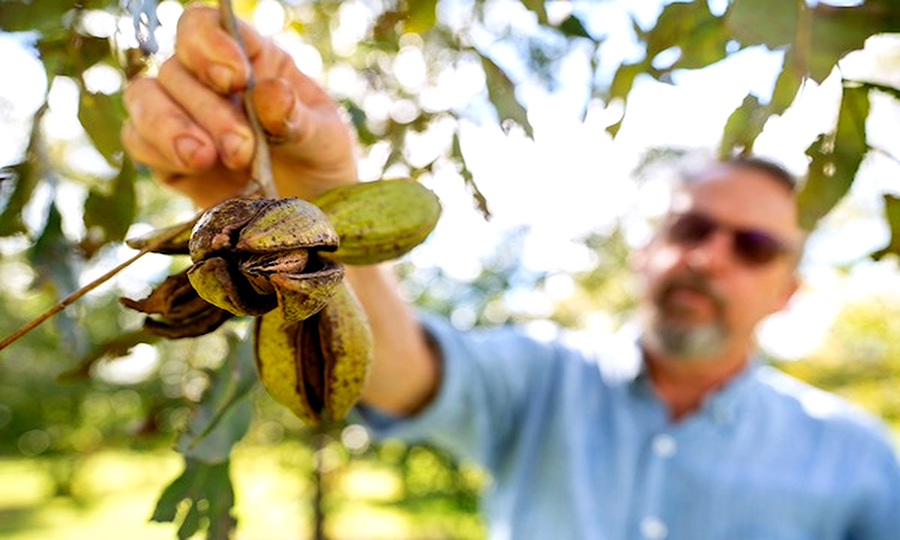
Texas A&M AgriLife Extension pecan specialist Monte Nesbitt plucks a perfectly ripe nut from a pecan tree. Photo Courtesy Laura McKenzie, Texas A&M AgriLife
Harvest is starting for the 2025 Texas pecan crop with experts expecting an average yield.
“This year would be considered average — maybe mediocre,” said Monte Nesbitt. AgriLife Extension pecan specialist and assistant professor in the Texas A&M Department of Horticultural Sciences. “Some regions are looking at decent yields, but weather conditions created challenges for others, and crop losses are expected.”
Nesbitt forecast the state’s crop at 32 million pounds, a number near the middle of recent production history.
Texas’ record high pecan production was 91 million pounds in 1979, while the 1951s crop was a record low 5 million pounds.
“There are commercial producers in northeast Texas that have produced good crops this year, because they contended well with the added disease pressure in the region,” Nesbitt said. “Local conditions vary, but [I] expect that there will be significant numbers of non-commercial or dooryard pecan producers in northeast Texas that experience nuts that are damaged from Pecan Scab disease.”
Scab is the No. 1 biological threat to pecans, and it was back in full force this year, Nesbitt said. Crop damage from scab shows up at harvest either as poor-quality nuts or a reduced number of nuts available to harvest.
“I’ve spoken to producers in the region — perhaps more east of the Dallas area proper that lost their entire crop to Scab,” he said. “Scab disease must be prevented on susceptible varieties in the May to July part of the season with fungicides; not something that’s easily accomplished in urban-suburban settings.
Nesbitt said the majority of improved or “papershell” pecan varieties are susceptible to Scab, with exceptions like Elliott and Kanza. “Native pecan trees have a wide range of resistance or susceptibility to Scab, so certain trees may exhibit better nut production than others due to their inherent genetic resistance,” he said.
Pecan harvest in Texas typically begins in late September or early October and continues through the late fall and early winter, depending on the variety and specific growing conditions.
The harvest starts when the pecans’ outer husks split open, indicating the nuts are ready to fall from the trees. Early maturing varieties, such as Pawnee, can begin harvesting sooner, while later varieties are harvested later in the season.
The most important indication of ripeness is when the green husks begin to split, and pecans start dropping from the tree.
Collect the fallen pecans as soon as possible to prevent them from becoming wet, muddy or being taken by scavengers like squirrels and crows. After picking up the nuts, store them in a cool, dry place for a few weeks to cure. That helps them dry out and makes shelling easier.
Pecan trees often follow a cycle of heavy and light crop years, which can influence the overall harvest.
Even as growers look toward the upcoming harvest, market prices remain a pressing concern for producers, Nesbitt said. Wholesale pecan prices have lingered below $2 per pound in recent years, creating financial strain for many producers.
“There’s frustration across the industry,” Nesbitt said. “Growers don’t understand why prices are so low. It shouldn’t be from oversupply since domestic production has not been really high. It’s generally thought to be a mix of global trade factors and a reduction in the number of shellers.”
Retail and direct-to-consumer sales remain strong, with increased consumer awareness of expanded ways to cook with pecans beyond traditional holiday baking. Promotion at state, national and local levels are helping boost that awareness, Nesbitt said, but the wholesale outlook remains uncertain.
“There’s optimism that new markets, like India, could help,” he said. “But right now, the perception among many growers is that current wholesale prices are not sustainable.”
Meanwhile, researchers like Nesbitt continue to work on solutions for pecan scab and other pest and disease issues that increase costs and hamper production.
“The good news is that scab-resistant varieties exist,” Nesbitt said. “We’re working to identify and develop trees that can hold up and produce good pecans with fewer inputs. That’s the future for growers and homeowners alike.”
For more stories about the Wylie community see the next print, or digital edition of The Wylie News. Subscribe today and support local journalism.











0 Comments